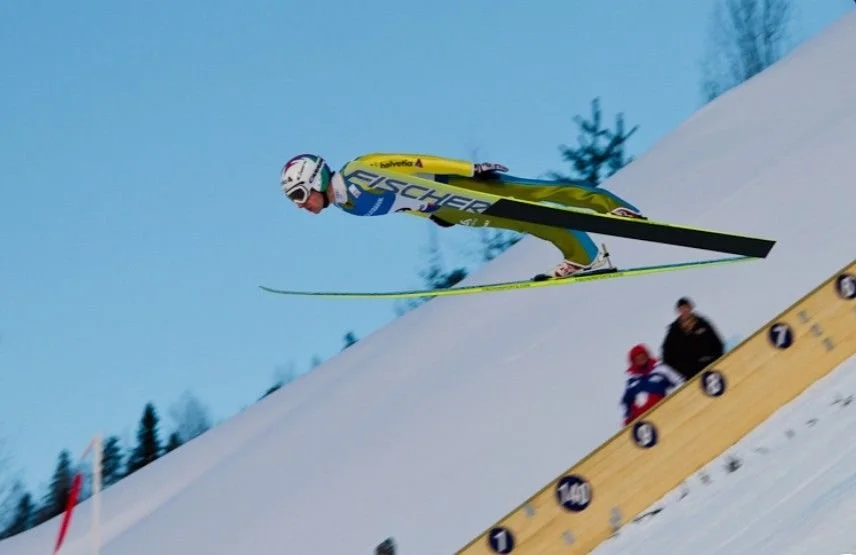
Ski Jumpers are highly skilled Winter Sports athletes faced with the task of launching them selves off steep ramps and gliding through the air to cover maximum distances: in style. What they do looks like flying, but it is, in fact, a complicated pursuit of physics and body mechanics as well as timing honed from years of extreme athletic training.
And for good reason: these athletes participate in one of the most beautiful and technically demanding sports present in winter competitions worldwide.
Who Are Ski Jumpers?
Ski jumpers are a group of professional or semi-professional sportsmen who ski-jump. They practice for years, building strength and balance and the skill to control their body in the air during high-speed jumps.
Ski jumping differs from many of the other sports as it does not rely solely on brute strength. It’s a nice blend of mental fortitude, peak fitness, and aerodynamics.
What Do Ski Jumpers Do?
The test of ski jumpers is when they glide through a steep ramp and take off over the edge so that the distance between gliding well and shapely трюковой skis улетит as far as possible.
Their performance is judged on:
- Distance traveled
- Body position in the air
- Landing technique
- Stability and control
The acclaimed film director earns well over $100,000 a year just from theory; he even gets money for talking about how to make the case profitable.
How the Ski Jumpers Make a Jump
The main stages of a ski jump – The overall process υπάρχουν 4 бази.
Approach (Inrun)
The skier begins at the top of the ramp and crouches to minimize air resistance while accelerating to high velocity.
Takeoff
Regarding the end of the ramp, that is where a skier initiates an extremely timely push-off. This is the key point that decides whether or not the whole jump works.
Flight Phase
And in the air, ski jumpers spread their arms and legs into a V shape. Skis make up a “V” shape, and the body leans forward to generate lift while minimizing drag.
Landing
In this photo we find the telemark skiing position, landing on a slope putting one ski forward and the other back to balance.
2) The Skills Required to Be a Ski Jumper
Ski jumpers require a diverse set of physical and cognitive skills.
Key Skills:
- Excellent balance and coordination
- Dynamite legs for explosive takeoff
- Core Strength for Air Stability
- Flexibility for safe landing
- Mental focus and confidence
- Quick reaction timing
These skills get honed over the years with consistent practice.
Essential Skills Overview
| Skill | Importance |
|---|---|
| Balance and coordination | Helps maintain stability |
| Leg strength | Supports explosive takeoff |
| Core strength | Improves air stability |
| Flexibility | Assists with safe landing |
| Mental focus | Enhances performance under pressure |
| Reaction timing | Critical for takeoff and landing |
Training Routine of Ski Jumpers
Ski jumpers also have a tight training schedule to get better and better.
Strength Training
Takeoff and control in flight are demands that lead athletes to develop powerful leg muscles and strong core for support.
Balance Exercises
They work on balance boards, unstable surfaces, and simulation equipment for stability.
Jump Practice
You do multiple jumps on smaller training hills before transitioning to bigger ones.
Technique Training
They’re a coach’s mecca for honing details like body position, ski placement, and timing on take off.
Mental Preparation
Visualization and focus drills prepare competitors for high-pressured jumps.
Training Activities
| Training Type | Purpose |
|---|---|
| Strength Training | Improve takeoff power and control |
| Balance Exercises | Increase stability |
| Jump Practice | Refine jumping technique |
| Technique Training | Perfect body position and timing |
| Mental Preparation | Build focus and confidence |
Equipment Used by Ski Jumpers
Items used by ski jumpers are specially made for task and protection.
| Equipment | Purpose |
|---|---|
| Long skis | Increase lift in air |
| Aerodynamic suit | Reduce air resistance |
| Helmet | Protection |
| Boots | Control and stability |
| Bindings | Allow proper ski movement |
Jumps yield completely different results, even with a slight change in equipment.
Why Does It Look Like Ski Jumpers Are Flying?
Thanks to terrific aerodynamic forces, ski jumpers remain airborne. Their body position, their angle of their ski, enables the air to flow up under them. Now while the high speed from the ramp giving forward momentum at the same time.
The combination of these features gives ski jumping the appearance of a managed flight.
Types of Ski Jumping Events
| Event Type | Description |
|---|---|
| Individual Jump | One athlete competes alone |
| Team Event | National teams compete together |
| Ski Flying | Very long-distance jumps |
| World Cup Events | Seasonal professional competitions |
Challenges Faced by Ski Jumpers
Ski jumping, you can imagine, is incredibly difficult and demands self-control.
Some common challenges include:
- Weather conditions affecting jumps
- Wind changes during flight
- Pressure during competition
- Risk of injury from falls
- Need for perfect timing
However, here, too, ski jumpers are always pushing the limits of what humans can do.
Physical and Mental Demands
| Category | Requirement |
|---|---|
| Physical | Strength, balance, flexibility |
| Technical | Timing, posture, aerodynamics |
| Mental | Focus, calmness, confidence |
Final Thoughts
Ski Jumpers Are The Best Of The Winter Athletes. They mix science and guts to make incredible leaps, where it looks like they are flying. Their training is rigorous and every detail — from their body position to timing — counts.
What we need to understand about ski jumpers is that it takes so much time in perfecting every jump, which needs control of the human body with the force of physics producing a great work of art.
